
How long does it take to see results from nutrition coaching?
November 4, 2026 | Recoup Owners

How long does it take to see results from nutrition coaching?
You want to know when the effort will start showing. Nutrition coaching has no single results timeline: a more manageable eating routine and a measurable body change are different outcomes, so your coach should help you define what you are looking for and when to review it.
TL;DR
- How long to see results from nutrition coaching depends on your goal, starting point, and follow-through.
- Easier food decisions count as progress, but do not prove a body-composition change.
- Agree on what to track and when to review it with your coach.
- Recoup Personal Training offers nutrition coaching alongside personal training in Costa Mesa.
HOW LONG UNTIL YOU SEE RESULTS?
Start by naming the result. Do you want lunch to stop disappearing from your day? Do you want your clothes to fit differently? Both deserve attention, but they need different evidence.
A coach cannot give you a meaningful deadline without understanding that distinction. Feeling understood by your personal trainer matters because the plan has to account for the person following it.
| Your goal | What to look for |
|---|---|
| More consistent meals | Agreed habits happening during ordinary weeks |
| Less daily food negotiation | Workable choices for recurring situations |
| A weight-related change | A trend across comparable check-ins |
| Better support for training | Food habits reviewed alongside your training experience |
Define the result before judging the timeline. Otherwise, you can miss practical progress while waiting for a different kind of change.
EASIER DECISIONS ARE A REAL RESULT
You finish a demanding day, open the refrigerator, and realize dinner is another decision you have not made. The issue is not necessarily knowing what to eat. It is having to figure it out when your capacity is already spent.
A useful coaching goal could be having a realistic dinner option decided before that moment. Another could be knowing what you will do when an appointment runs through lunch.
Those changes are worth recognizing. They describe a routine you can repeat, not another plan that only works when life settles down. They also have limits: less dinner stress is not evidence of fat loss.
BODY CHANGES NEED THEIR OWN EVIDENCE
If changing your weight or body composition matters to you, say so plainly. You do not need to replace that goal with something that sounds more acceptable.
Ask your coach what you will measure, how you will compare check-ins, and when you will discuss the pattern. Use each measure for the question it can answer. An easier eating routine, a change in how clothes fit, and a weight reading are not interchangeable proof.
WHAT AFFECTS THE TIMELINE?
- Your starting point. Building a regular eating routine is different from refining habits you already practice.
- Your goal. Meal planning and body changes should not share an assumed deadline.
- What you can repeat. A plan that needs an unusually quiet week needs adjustment for ordinary life.
- Your responsibilities. Travel, caregiving, and changing schedules belong in the plan.
- Your health context. Symptoms, medical conditions, or medications can require clinical input beyond nutrition coaching.
Consistency does not mean defending a perfect record. If preparation takes too long or the food does not work for your household, tell your coach. You still have a role in trying the agreed approach and communicating honestly, but the plan needs to respond to what you learn.
MAKE CHECK-INS USEFUL
Agree on what to track and how you will use it.
- Define the goal. Name what you want to be different.
- Choose the evidence. Track observations that answer that question.
- Review the pattern. Include ordinary weeks, not just your most organized days.
- Adjust the plan. Decide what changes and why.
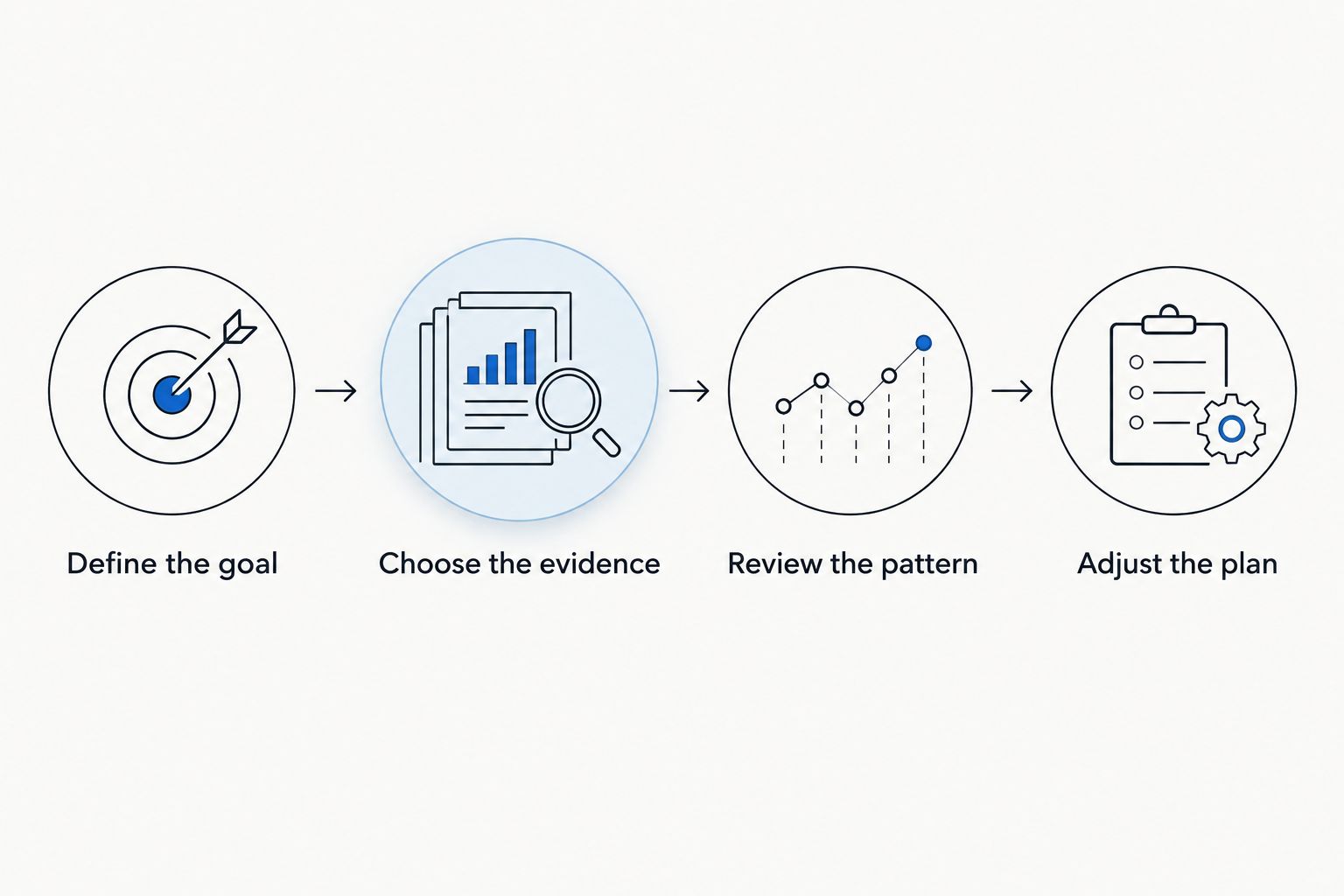
If you are following the plan without the intended result, bring that directly to the review. Check whether the plan is happening as understood and whether the evidence matches the goal before adding restrictions. Medical questions belong with an appropriately qualified clinician, not an unsupported coaching diagnosis.
FAQ
How long should I give nutrition coaching before expecting results?
Agree on a review point with your coach based on your goal. A universal deadline cannot tell you whether your particular plan is working.
Can nutrition coaching help if my weight stays the same?
Yes. More workable eating habits are a separate outcome, not proof of fat loss.
Do I have to track everything I eat?
Ask what tracking is needed and why. Collect information that serves your goal and is practical to provide.
What if travel disrupts my routine?
Bring the recurring travel situations into the plan. They are part of your life, not an exception to ignore.
Can a nutrition coach change my medication?
Medication decisions belong with an appropriately qualified clinician. Nutrition coaching should stay within the coach’s qualifications.
Does Recoup offer nutrition coaching in Costa Mesa?
Yes. Recoup Personal Training offers nutrition coaching alongside personal training at its Costa Mesa studio.
BRING THE PART THAT KEEPS REPEATING
Before speaking with a coach, write down an eating decision that keeps getting difficult. Where were you, what was happening, and what got in the way? That detail gives the conversation somewhere useful to begin.
Recoup Personal Training fits adults seeking nutrition coaching alongside personal training in Costa Mesa. If you are coming from Newport Beach, include the journey in the discussion about what works for you.
TALK THROUGH WHAT FITS
Book a free discovery call to discuss your goals, your routine, and the support you want.
RELATED GUIDES


